Animations.

I have animated Shot001-Shot005, just waiting for final approval from Angus that these look scientifically correct.  The opening shot looked really bland using a straight zoom as detailed in the animatic, so instead I got some inspiration from this impossibly beautiful shot from Inside the Human Body.

jellyfisheggI found that the Jiggle Deformer (most evident in Shot002, but not yet included in all shots as I haven’t cached them all yet) helps with the realism and makes the molecules look a bit more lively.

Shot002 relied heavily on the animation of constraints to make the ubiquitin molecules transfer from HDM2 to p53.

ConstraintShot003 was great fun and really quick to do, using a Motion Path and the “Side Twist” attribute to produce a forward rolling motion.

motionpathShot005 was a complete nightmare (probably because it was the one shot I hadn’t done enough testing for), and went through several iterations inluding trying to squash it though a lattice, which produced results that were… not quite what I was hoping for.

LatticeIn the end I used a Spline Rig similar to the one I used for mRNA to give the impression that the protein was “unwinding.” I’ll have to use clever comp and shading techniques to make it look like it’s still the original model.  I’m not totally happy with the final result, but time is ticking so it’ll have to be one of those “fix it in comp” jobs.  Motion blur will go a long way toward achieving this, I suspect.

Rig

The Blue Planet

Suffered a creative block yesterday so I decided to take John’s advice and go take some underwater film footage. Well, sort of. Underwater video cameras and diving holidays are somewhat outside my budget so I settled on the next best thing: The Blue Planet.

I watched two episodes: The Deep and Coral Seas.  Got some good screen grabs, which have got me inspired to do more texturing and lighting based on the footage.CoralSeas002 CoralSeas005 CoralSeas007 CoralSeas008 CoralSeas010 CoralSeas011 CoralSeas012 CoralSeas013 TheDeep003 TheDeep010 TheDeep016 TheDeep020 TheDeep025

Colour Psychology

This morning I was fiddling about with a shader for my HDM2 molecules, but I just kept changing my mind. I realised that I would need to lock down exactly what colour each molecule would be to avoid wasting time, but I would need a system.

So, at the risk of sounding a bit like one of those people who read your horoscope, I’ve been looking into colour psychology. Most specifically Western colour psychology, I know that many  cultures imbue colours with completely different meanings but I had to narrow it down somehow and I’m most familiar with Western customs.

I made a list of the colours and some keywords explaining the feelings and ideas each colour evokes (with reference to a few online links and my own experience), then assigned a “character” to each molecule based on their role in the cell.  It sounds woolly, I know, but it’s the best system I’ve come up with.

Colour psychology links:

http://www.luminous-landscape.com/tutorials/colour_theory.shtml

http://psychology.about.com/od/sensationandperception/a/colorpsych.htm

http://www.infoplease.com/spot/colors1.html

Red: danger, passion, love, warmth, intensity, anger, action

Yellow: warning, happiness, frustration, cowardice

Blue: passivity, calm, sadness, productivity, loyalty, poison

Orange: excitement, enthusiasm, warmth, sociability

Green: Nature, tranquillity, health, jealousy

Purple: royalty, luxury, wisdom, spirituality, creativity

Pink: love, romance, tranquility

Brown: strength, reliability, comfort, security

White: Purity, innocence, sterility

Black: Evil, magic, death

Grey: conservative, boring

HDM2: Attaches ubiquitin (tagging molecules) to p53 to mark it for destruction.

Keywords: dutiful, worker, trustworthy

Colours: brown, grey

Ubiquitin: so called because it is “ubiquitous” – one of the most common molecules in the cell. Tags proteins for destruction.

Keywords: natural, life cycle

Colours: green, white

Proteasome: Destroys tagged proteins.

Keywords: destruction, obliteration

Colours: black, red

p14: Binds to HDM2 to prevent p53 destruction cycle from taking place.

Keywords: action, energy

Colours: orange

Ribosome: creates proteins.

Keywords: Production, creativity

Colours: Blue, purple

p53R2: Created through p53 DNA binding. Repairs DNA.

Keywords: fixer, heroic

Colours: brown, orange

p53: Tumour-suppressor protein, binds to DNA to begin creation process.

Keywords: facilitator, heroic

Colours: red, orange

Playgrounds Fest 2012 Main Titles

The more I see of the work of MRK, Jordi Pagès and Gabor Ekes, the more I love it.  It’s all very surreal, but there is much for me to learn from the use of texture, colour and sound.  I particularly love the section from 00:40-01:33, it looks so… alive. I recently learned that a similar effect can be achieved with something as simple as a lattice made into a soft body, attached to a turbulence field… tests to follow shortly.

Link

Jellyfish Pictures: Human Body Reel

This. This a thousand times over. If I manage to get my work to look even one percent as glorious as this, I will be very happy.

On a slightly less effusive note… I am making notes on everything in this, particularly the use of random floating particles to create an underwater vibe.

In addition to this are other things I will endeavour to utilise:

– focus plane adjustments

– procedural textures (I think?)

– a slight vignette around the edges of the screen

– particle trails

– the fact that the shaft of yellow light bearing down on the egg looks awesome and I should use that same effect on my own DNA (in the project obviously, not my actual DNA)

– dynamic environments (the fallopian tube lining was made by “collapsing” some dynamic cloth to make those random-looking folds that give slightly under the weight of the egg. Maybe a bit ambitious for this project, but worth noting)

A Question of Scale

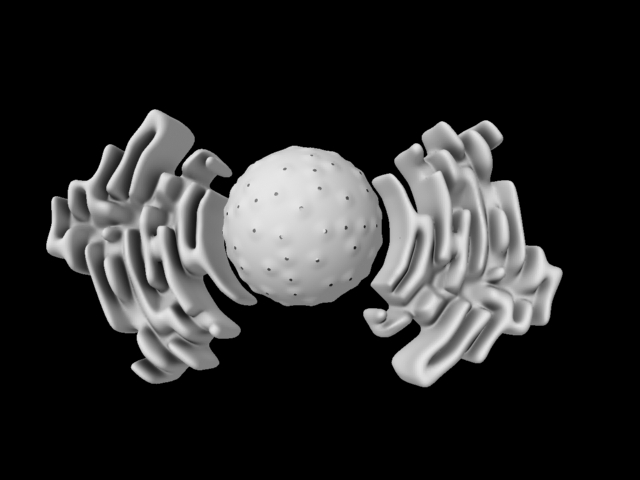
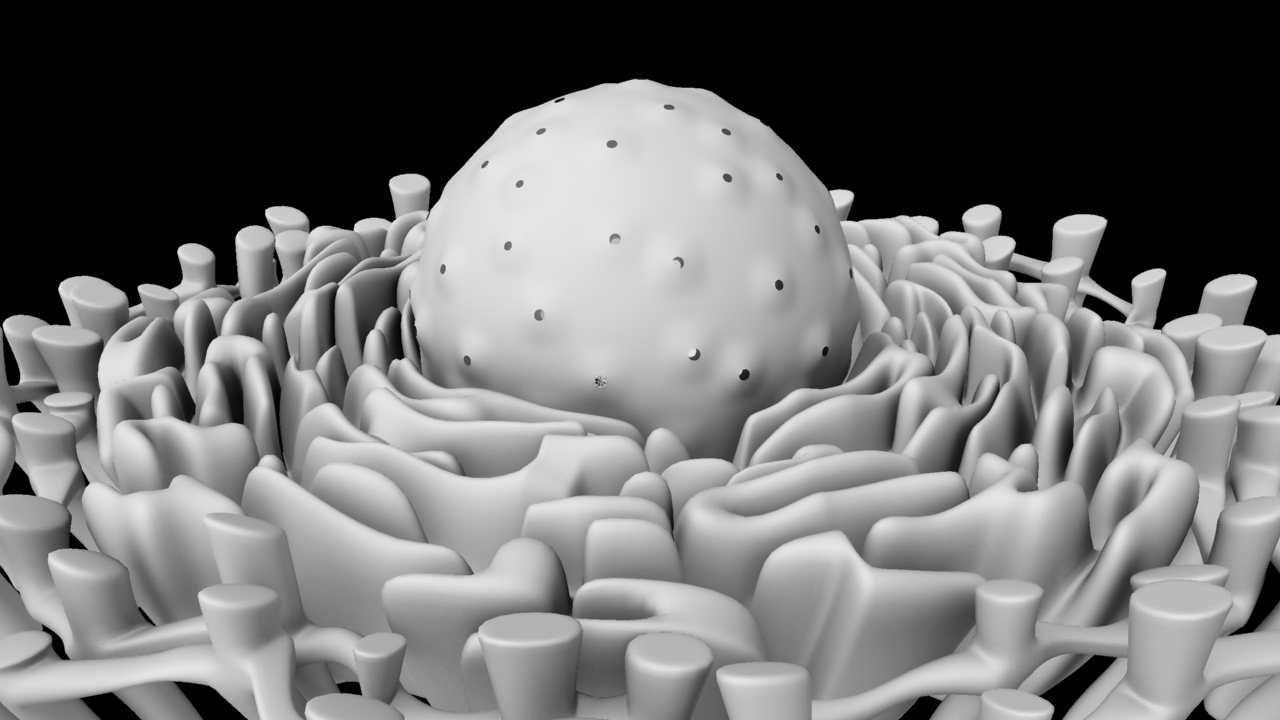
So I’ve been doing some more work on the nuclear envelope and endoplasmic reticulum (ER for short) and I’ve been having a bit of trouble trying to determine the exact scale to work to.

This is my original storyboard sketch of that establishing shot:

0010This was largely based on a drawing in The Biology Coloring Book (Griffin and Vadala, 1986).

P1000712This was what I ended up with, as I posted earlier:

RERI decided to look up some artistic interpretations of this part of the cell for additional reference.  I found this from The Flow: (MRK, 2012)

Still image from The Flow by MRK 004And this, from Secret Universe: The Hidden Life of the Cell (BBC, 2012)

NucleusbbcWhat I instantly noticed was that the ER in these shots seems to go on forever (an impression assisted by copius amounts of depth of field. And FOG), and be much more densely packed around the nucleus.  The result is a much greater sense of – for lack of a better word – epic-ness. And scale.  The cell just seems bigger in these shots.  Yes, a cell is really extremely tiny (a fact re-iterated by my biology student sister who spent many frustrating hours trying to extract a cell nucleus, only to accidentally crush it with what was, relatively speaking, an ENORMOUS needle).  But if you were to shrink down to the size of a virus, or, say – a p53 molecule, the cell would seem immeasurably huge.  I realised then that I should be aiming for a larger sense of scale.  Plus, it would save me the hassle of modelling the other organelles in the background. Considering that modelling the ER proved insanely difficult, this would be a welcome change.

So I’ve re-jigged the model somewhat.  Not sure that it’s quite there yet – the nuclear pores still seem a bit big – but I think it’s better than before. I may experiment with changing the focal length of the camera too, to alter the scale.

composition

Sketching

CCF14012013_00000CCF14012013_00001CCF14012013_00002CCF14012013_00003CCF14012013_00004I got my feedback for Semester One’s work at the end of last week, and I was extremely pleased with my grades.  There is always room for improvement however, and John’s primary suggestion was that – having already demonstrated that I can learn and use the technology well – I spend more time focusing on the artistic side of things.  So I’ve bought a new sketchbook and I’m now trying to articulate what are – frankly – some pretty crude-looking scientific diagrams in my own style.

p53

Yes. Exactly.

I’ve also been watching the BBC’s “Secret Universe: The Hidden Life of the Cell” again armed with greater scientific knowledge than I had last time I watched it, and it’s interesting to see how they have interpreted the different organelles, many of which I can now identify by name.  For example, the cytoskeleton (top image) appears in microscope slides much as I have drawn it there – organic and sort of cotton-like – however the creative brains at Intelligent Creatures have represented it here as a sort of geometric cellular scaffolding.

Still image from Secret Universe - The Hidden Life of the Cell by the BBC (Animation by Intelligent Creatures) 006The real question is – how much can I get away with? Granted, scientists’ ribbon diagrams can tell you how something is stuctured – but knowing the chemical structure of something is very different to knowing what something looks like (much as if one were trying to draw La Sagrada Familia based on the shape of the scaffolding alone).  The news that – only six weeks ago – DNA was photographed for the first time ever reminded me that we really know nothing at all.

dnapicture2My conclusion is that p53 probably looks a lot more interesting than the lump of balls I’ve drawn it as, and even if it doesn’t… for storytelling purposes, it’s important to me that my story’s hero look more momentous than a lump of balls. So it’s back to the drawing board (book?) tomorrow for another attempt.