The Blue Planet

Suffered a creative block yesterday so I decided to take John’s advice and go take some underwater film footage. Well, sort of. Underwater video cameras and diving holidays are somewhat outside my budget so I settled on the next best thing: The Blue Planet.

I watched two episodes: The Deep and Coral Seas.  Got some good screen grabs, which have got me inspired to do more texturing and lighting based on the footage.CoralSeas002 CoralSeas005 CoralSeas007 CoralSeas008 CoralSeas010 CoralSeas011 CoralSeas012 CoralSeas013 TheDeep003 TheDeep010 TheDeep016 TheDeep020 TheDeep025

Show Your Working: RER Reference Images

There’ll be a few of these “Show Your Working” posts going up, as one of the main points from my feedback meeting was that I had to be more explicit about my real-world references, rather than just other CG films that had inspired me.

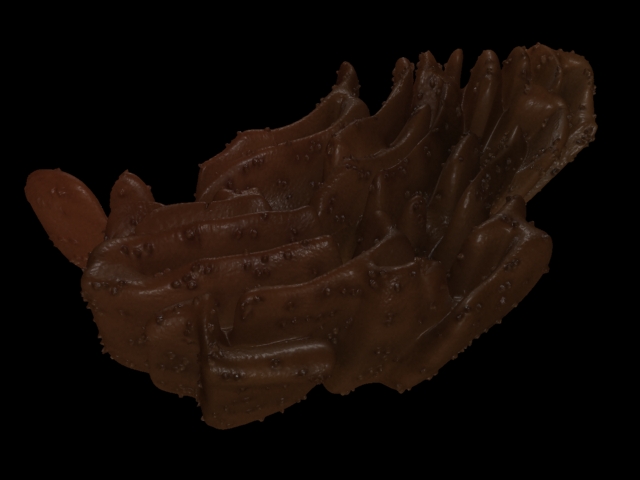
The mental image I have of the rough endoplasmic reticulum is like that of battered and rough skin.  Fortunately, I already have sculpting experience in that area, from creating the whale for Going Live.  Therefore I used a lot of my whale images from that to create a scratched texture.

Rough Endoplasmic Reticulum – Shader Build

So since my last post I have had to completely redo the RER sculpt as my UV map wasn’t up to scratch, which was frustrating.  But now I know how to lay out UVs properly so hopefully I won’t run into the same problem again.

The resulting image was fairly similar to the one in the previous post (albeit less distorted), so I had to find a way to get the texture to come through as the layers of the SSS shader were causing the dark details to be washed out.

Doing a bit of snooping on my classmate Scott Dunbar’s blog, I saw that he made the scatter layers by changing the colours of the original texture.  So I did the same with mine, as well as extracting an AO map and layering it over the texture for extra shadow and detail:

Diffuse (Weight: 0.2)

RER_Diffuse_Diffuse_AOBakeEpidermal (Original Mudbox Texture) (Weight: 0.4)

RER_Diffuse_Epidermal_AOBakeSubdermal (Weight: 0.2)

RER_Diffuse_Subdermal_AOBakeBack (Weight: 0.2)

RER_Diffuse_Back_AOBakeFinal result:

RER_DispFinal

Sculpting

Image

Sculpting

Finally got all the shaders done and started work on sculpting today, making sure that the “Rough” Endoplasmic Reticulum lives up to its name. Similar to the “Barnacle Brush” Vector Displacement Map I made for the whale in Going Live, I made a Ribosome brush (much to the amusement of my final-year Cell Biology student sister). The sculpt isn’t finished yet but I decided to do a test in Maya before I take it any further. There are a few artifacts I will have to take a look at, most likely they’re down to Anti-Aliasing settings on export.

New mRNA

Image

New mRNA

I made a new mRNA, which Angus is happy with, and I’m happy with, and it deforms better so Maya is happy too.

What I found interesting about the process or making this model is that, creatively speaking, I had hit a wall.  I just didn’t know what to do with it to make it look good.

Many people – including myself before I started this project – tend to think of “scientific accuracy” and “aesthetic” as opposing forces, with the dark agents of Truth reining in creative minds.  Examples such as this have proven to me that in many cases the opposite can be true.  I had utilised my creativity based on a very vague description of mRNA and its function, and my creatvity failed me.  The model looked terrible.

Science, in this case, stepped in.  Armed with Angus’ more detailed description of the mRNA – sinuous, like a thin ribbon with bases, similar to DNA but only one half of the double helix, and with proteins attached – I was able to make something that was, in fact, much more beautiful than what my creative mind had been able to come up with by itself.

Molecular Shaders

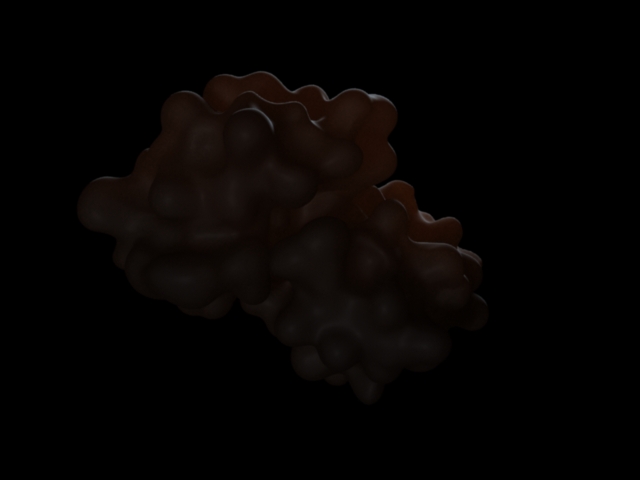
HDM2 p14 p53 p53R2 Proteasome Ribosome UbiquitinHad a very productive day on Friday, built seven SSS shaders from scratch.  From top to bottom: HDM2, p14, p53, p53R2, Proteasome, Ribosome, Ubiquitin.  On to texturing now – though now that I’ve seen these together I might make a few changes to make different molecules more discernible.  What’s most important is that the translucency and soft shadows of the SSS have allowed me to swerve the “sci-viz” aesthetic I’m keen to avoid (generally a default Blinn with an oversaturated Diffuse channel and way too much specular, or no specular at all).

Colour Psychology

This morning I was fiddling about with a shader for my HDM2 molecules, but I just kept changing my mind. I realised that I would need to lock down exactly what colour each molecule would be to avoid wasting time, but I would need a system.

So, at the risk of sounding a bit like one of those people who read your horoscope, I’ve been looking into colour psychology. Most specifically Western colour psychology, I know that many  cultures imbue colours with completely different meanings but I had to narrow it down somehow and I’m most familiar with Western customs.

I made a list of the colours and some keywords explaining the feelings and ideas each colour evokes (with reference to a few online links and my own experience), then assigned a “character” to each molecule based on their role in the cell.  It sounds woolly, I know, but it’s the best system I’ve come up with.

Colour psychology links:

http://www.luminous-landscape.com/tutorials/colour_theory.shtml

http://psychology.about.com/od/sensationandperception/a/colorpsych.htm

http://www.infoplease.com/spot/colors1.html

Red: danger, passion, love, warmth, intensity, anger, action

Yellow: warning, happiness, frustration, cowardice

Blue: passivity, calm, sadness, productivity, loyalty, poison

Orange: excitement, enthusiasm, warmth, sociability

Green: Nature, tranquillity, health, jealousy

Purple: royalty, luxury, wisdom, spirituality, creativity

Pink: love, romance, tranquility

Brown: strength, reliability, comfort, security

White: Purity, innocence, sterility

Black: Evil, magic, death

Grey: conservative, boring

HDM2: Attaches ubiquitin (tagging molecules) to p53 to mark it for destruction.

Keywords: dutiful, worker, trustworthy

Colours: brown, grey

Ubiquitin: so called because it is “ubiquitous” – one of the most common molecules in the cell. Tags proteins for destruction.

Keywords: natural, life cycle

Colours: green, white

Proteasome: Destroys tagged proteins.

Keywords: destruction, obliteration

Colours: black, red

p14: Binds to HDM2 to prevent p53 destruction cycle from taking place.

Keywords: action, energy

Colours: orange

Ribosome: creates proteins.

Keywords: Production, creativity

Colours: Blue, purple

p53R2: Created through p53 DNA binding. Repairs DNA.

Keywords: fixer, heroic

Colours: brown, orange

p53: Tumour-suppressor protein, binds to DNA to begin creation process.

Keywords: facilitator, heroic

Colours: red, orange

Collaborator Meeting 23-05-2013: Notes

Today’s meeting with Angus was interrupted by champagne (welcome) and two fire alarms (less welcome) but we still managed to talk about a lot. Mostly about the narration, but about a couple of other points too.

– The mRNA backbone is too thick, compared to the other organelles it’s really tiny so I need to fix this. There are also proteins bound to it at all times (“heterogeneous mRNA binding proteins,” such as hnRNP), so I should show them.

– Sometimes the animatic is not quite clear whether we are in the nucleus or the cytoplasm.  The colouring and shading, therefore, should be very different to make it more clear (or introduce the environment in the narration).

A few amendments to the animatic narration:

– It may be worth mentioning that p53 is simply one of the most important in a great number of proteins responsible for tumour suppression.  This is not imperative though – it depends on whether I can find a way to fit it in that doesn’t sound clumsy.

– What is imperative is that unchecked DNA damage does not always result in cancer – normally it results in apoptosis.  Only if the UV rays damage the genes responsible for regulating cell division, does a tumour form.

– “p53 is now free to initiate…” is not technically correct. Rather, “p53 is no longer degraded and now quickly accumulates (Angus’ analogy was that of water draining away, being stopped by a plug).”

– It is worth saying (probably at the end) that the reason for many cancers forming is an abnormailty in the p53 (or the p14) gene.